
Summary
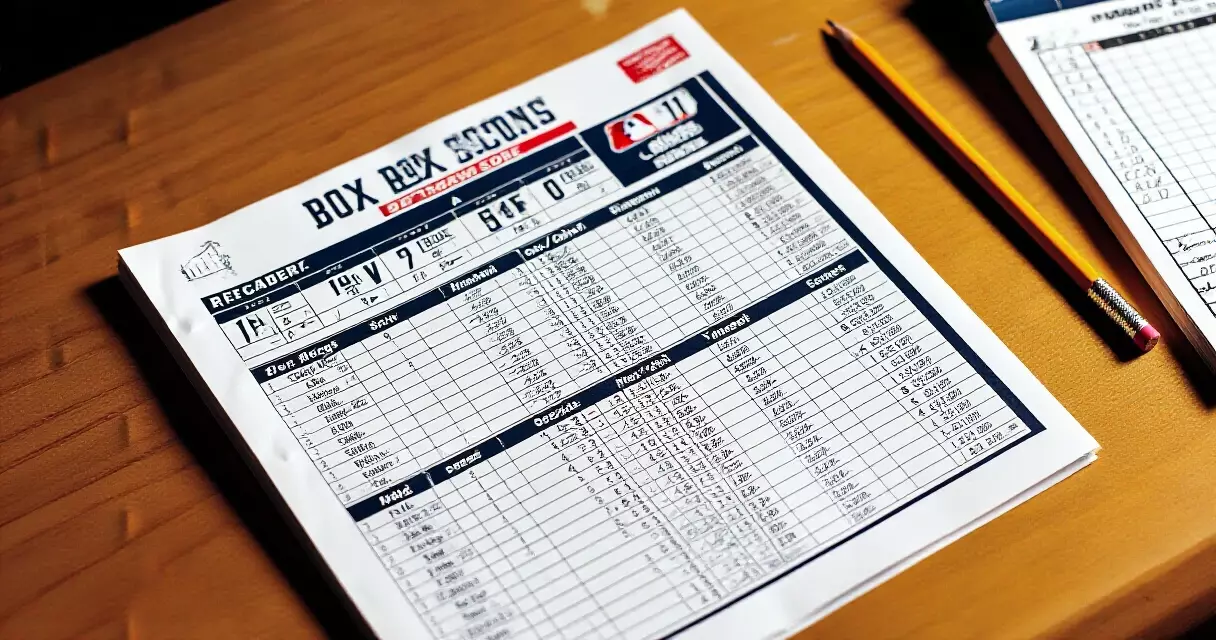
A single Major League Baseball box score packs more than 100 individual data points into a grid roughly the size of a postcard, condensing a three-hour contest into rows and columns a trained reader can scan in under a minute....
Table of contents
- 1 Why the Box Score Still Matters
- 2 A Short History of the Box Score
- 3 The Line Score: Runs, Hits, and Errors at a Glance
- 4 Reading the Batting Lines
- 5 Reading the Pitching Lines
- 6 Decoding the Abbreviations and Symbols Below the Grid
- 7 From Box Score to Advanced Stats
- 8 Putting It Together: Reading a Full Box Score
- 9 Common Mistakes When Reading a Box Score
- 10 Frequently Asked Questions
- 10.1 What does an “X” mean in an MLB line score?
- 10.2 Why are runs and earned runs sometimes different for a pitcher?
- 10.3 What is the difference between AVG, OBP, and SLG?
- 10.4 How do I read innings pitched like 6.2?
- 10.5 What does LOB mean and why does it matter?
- 10.6 Who invented the baseball box score?
- 10.7 Is a higher or lower WHIP better for a pitcher?
- 10.8 Where can I find official MLB box scores?
- 11 Sources
- 11.1 Further reading
- 11.2 Further reading
A single Major League Baseball box score packs more than 100 individual data points into a grid roughly the size of a postcard, condensing a three-hour contest into rows and columns a trained reader can scan in under a minute. The format traces back to the 1850s, yet the modern version still answers the same questions a fan asked 160 years ago: who scored, who pitched, and how each player contributed. Learning to read one turns a wall of abbreviations into a clear narrative of the game. This guide breaks down every section of an MLB box score, defines the stats line by line, and shows how the numbers connect to the story a recap tells.
Why the Box Score Still Matters
Television graphics, live win-probability meters, and pitch-tracking overlays have multiplied the ways fans follow baseball, but the box score remains the official shorthand record of what happened. Every game produces one, and it is the document scorers, reporters, and historians return to when they need to confirm a result. According to the Wikipedia entry on the baseball box score, the format is designed so that a reader who never saw the game can reconstruct its essential events from the printed lines alone.
The value is speed. A glance at the line score reveals the final margin and where the scoring clustered. A scan of the batting block shows which hitters drove the offense. The pitching block explains who held the lead or surrendered it. Understanding these blocks also makes longer recaps easier to follow, because most written summaries simply translate the box score into sentences. If you want a sense of how those recaps are built, the overview of what an MLB game summary contains walks through the same source data from the reader’s side.
A Short History of the Box Score
The box score is older than the World Series, the designated hitter, and the modern strike zone. English-born sportswriter Henry Chadwick is widely credited with developing the format in the late 1850s and early 1860s, adapting the cricket scorecard he grew up with into a grid suited to baseball. The Encyclopaedia Britannica entry on Chadwick describes him as a journalist who shaped how the game was recorded and reported, and he is often called the “Father of Baseball” for that contribution.
Chadwick also gave us several abbreviations still printed today. The letter “K” for a strikeout, according to the Wikipedia article on the strikeout, comes from his scoring shorthand, where K marked the last letter of “struck.” Early box scores tracked little beyond runs, hits, and outs. Over the following century the grid expanded to include walks, runs batted in, earned run average, and eventually the on-base and slugging figures that anchor modern analysis.
The leap from paper to pixels changed distribution rather than structure. A box score published on MLB.com in 2026 still uses the rows and columns Chadwick would recognize, even though it now links to pitch-by-pitch video. Readers who enjoy this kind of record-keeping history may find parallels in the evolution of cricket scorecards, the very format that inspired Chadwick in the first place.
The Line Score: Runs, Hits, and Errors at a Glance
At the top of every box score sits the line score, a compact table showing runs scored in each inning followed by three summary columns: R, H, and E. The away team appears on the top row and the home team below it, matching the order in which they bat. A standard game runs nine innings, so a line score usually has nine numbered columns plus the totals.
The final three columns carry the headline information. R is total runs, which decides the winner. H is total hits, a rough measure of offensive volume. E is errors, the defensive miscues officially charged by the scorer. A home team that leads after the visitors bat in the ninth does not need to take its final turn, which is why you will sometimes see an “X” in the home team’s ninth-inning box. Here is a sample line score with the columns labeled.
| Team | 1 | 2 | 3 | 4 | 5 | 6 | 7 | 8 | 9 | R | H | E |
|---|---|---|---|---|---|---|---|---|---|---|---|---|
| Away | 0 | 1 | 0 | 0 | 2 | 0 | 0 | 0 | 1 | 4 | 9 | 0 |
| Home | 0 | 0 | 3 | 0 | 0 | 0 | 1 | 1 | X | 5 | 8 | 1 |
Reading this example, the home team won 5–4 despite recording one fewer hit and committing the game’s only error. That mismatch between hits and runs is common and points to timing: the home club bunched its hits when runners were on base. The reading skill here is similar in spirit to interpreting any compact results grid, such as reading tennis scores, where the order and shape of the numbers tell you more than any single figure.
Reading the Batting Lines
Below the line score, each team gets a batting block listing players in the order they hit, with one row per batter. Substitutes appear indented beneath the starter they replaced. The columns to the right of each name record that player’s day at the plate. The core five are AB, R, H, RBI, and BB, and most modern box scores add strikeouts and a rate stat or two.
At-bats, abbreviated AB, count official plate appearances but exclude walks, hit-by-pitches, sacrifices, and catcher’s interference. That distinction matters because batting average divides hits by at-bats, not by total trips to the plate. A player who walks twice and singles once in four plate appearances is credited with one hit in two at-bats, a .500 average for the day. R counts runs that player scored personally, while RBI counts runs that player drove in. A solo home run produces one R and one RBI for the same batter.
The rate columns translate raw totals into context. Batting average (AVG) is hits divided by at-bats. On-base percentage (OBP) measures how often a hitter reaches base via hit, walk, or hit-by-pitch. Slugging percentage (SLG) weighs hits by total bases, so a double counts double a single. Many box scores now print a season-to-date figure beside the day’s line so you can see whether the performance was typical or an outlier. The table below defines the batting columns you will encounter most often.
| Abbreviation | Full name | What it measures |
|---|---|---|
| AB | At-bats | Official plate appearances, excluding walks, hit-by-pitches, and sacrifices |
| R | Runs | Times the player crossed home plate to score |
| H | Hits | Safe hits: singles, doubles, triples, and home runs |
| RBI | Runs batted in | Runs that scored as a direct result of the batter’s action |
| BB | Base on balls | Walks, four balls before three strikes |
| SO or K | Strikeout | Out recorded on three strikes |
| AVG | Batting average | Hits divided by at-bats |
| OBP | On-base percentage | Rate of reaching base by hit, walk, or hit-by-pitch |
| SLG | Slugging percentage | Total bases divided by at-bats |
| OPS | On-base plus slugging | OBP added to SLG, a quick power-and-patience gauge |
One reading habit pays off quickly: scan the H and RBI columns first to find who carried the offense, then check BB and SO to judge plate discipline. A batter with three hits and a walk had a strong day even if the box score buries the line in the middle of the order. The deeper analytical version of this skill mirrors the approach in analyzing cricket statistics from scorecards, where individual lines reveal who shaped the result.
Reading the Pitching Lines
The pitching block lists every pitcher who appeared, in the order they entered, with the starter on top. Each row carries a decision tag where relevant: W for the winning pitcher, L for the loser, S for a save, H for a hold, and BS for a blown save. These tags answer the question of who was officially responsible for the outcome, which is often the first thing a recap mentions.
Innings pitched, abbreviated IP, uses a notation that confuses newcomers. The number after the decimal point counts outs, not tenths of an inning. So 6.1 innings means six full innings plus one out, and 6.2 means six innings plus two outs. A pitcher who records every out of seven innings shows 7.0. ER stands for earned runs, the runs charged to a pitcher that scored without the help of an error or passed ball. R counts all runs allowed, earned or not, which is why the two columns sometimes differ.
Earned run average ties these figures together. According to the Wikipedia entry on earned run average, ERA equals earned runs allowed divided by innings pitched, multiplied by nine, which scales the rate to a full game. A pitcher who allows two earned runs across six innings posts an ERA of 3.00 for that outing. The table below summarizes the pitching columns.
| Abbreviation | Full name | What it measures |
|---|---|---|
| IP | Innings pitched | Outs recorded, expressed as innings plus thirds (.1 and .2) |
| H | Hits allowed | Safe hits surrendered to opposing batters |
| R | Runs allowed | All runs that scored against the pitcher |
| ER | Earned runs | Runs charged to the pitcher without an error or passed ball |
| BB | Walks allowed | Batters given a base on balls |
| SO or K | Strikeouts | Batters retired on three strikes |
| HR | Home runs allowed | Home runs surrendered |
| ERA | Earned run average | Earned runs per nine innings pitched |
Pair the IP and ER columns to grade an outing fast. A starter who throws seven innings and gives up one earned run had an excellent night regardless of strikeout total. A reliever charged with three earned runs in a third of an inning blew the game open, and the line will show it. Reading these rows in sequence also tells you how a manager handled the staff, since the order of pitchers reflects the in-game decisions that the recap will later explain.
Decoding the Abbreviations and Symbols Below the Grid
Underneath the batting and pitching blocks, a box score prints a set of notes that capture events the columns cannot. This section often goes ignored, yet it holds some of the most useful detail in the entire document. Lines labeled 2B, 3B, and HR list which players hit doubles, triples, and home runs, frequently with a season total in parentheses. A note reading “HR: Smith (12)” means Smith hit his twelfth home run of the year.
Other standard notes include E for errors with the responsible fielder named, DP for double plays turned, LOB for runners left on base, SB and CS for stolen bases and caught stealing, and SF for sacrifice flies. The LOB figure is especially telling, since a team that strands ten runners wasted scoring chances that a recap will almost certainly highlight. Reading these notes is what separates a surface scan from a real understanding of the game’s turning points.
Symbols and abbreviations vary slightly between publishers, but the core set is stable across MLB.com, newspaper agate, and historical archives. Anyone who has worked through a dense scoring key in another sport will recognize the discipline involved, much like the reference list of cricket scorecard symbols and abbreviations that performs the same job for that game.
From Box Score to Advanced Stats
The traditional grid gives you raw counts, but two derived numbers, OPS and WHIP, have become standard because they compress several columns into one reliable signal. Both can be calculated straight from box score data, which is why they now appear in many published versions.
OPS, on-base plus slugging, simply adds OBP and SLG. The Wikipedia entry on OPS notes that the figure rewards hitters who both reach base often and hit for power, and that a mark around .800 is generally considered good while .900 and above signals an elite season. Because it requires no special data, OPS bridges the gap between a casual box score read and deeper sabermetric analysis.
WHIP, walks plus hits per inning pitched, does the same job for pitchers. The Wikipedia entry on WHIP defines it as the sum of walks and hits allowed divided by innings pitched, a measure of how many baserunners a pitcher permits per inning. A WHIP near 1.00 is excellent, and a figure around 1.30 is roughly league average for a starter. The benchmark table below gives rough quality tiers for the rate stats discussed in this guide.
| Statistic | Elite | Good | League average (approx.) |
|---|---|---|---|
| Batting average (AVG) | .300+ | .270–.299 | ~.245 |
| On-base percentage (OBP) | .380+ | .340–.379 | ~.315 |
| OPS | .900+ | .800–.899 | ~.720 |
| ERA | Under 3.00 | 3.00–3.99 | ~4.10 |
| WHIP | Under 1.00 | 1.00–1.20 | ~1.30 |
Treat these tiers as guides rather than hard cutoffs, because run environments change. The numbers that defined an average hitter in a high-offense year look different in a pitching-dominant one, which is why every benchmark above carries an approximation note.
Putting It Together: Reading a Full Box Score
With the parts defined, a full read follows a simple order. Start at the line score for the final and the inning-by-inning flow. Drop to the batting blocks and find the players with the most hits and RBI, then note anyone with multiple walks or strikeouts. Move to the pitching blocks, read the decision tags, and check IP against ER to see who controlled the game. Finish with the notes below the grid for home runs, errors, and runners left on base.
Run that sequence on the sample line score from earlier and a story emerges. The home team scored three in the third, traded single runs late, and held on 5–4. If the batting block showed a cleanup hitter with two hits and three RBI, you would have found the engine of that third-inning rally without watching a pitch. This is exactly the raw material that feeds the daily recaps collected on the MLB game summaries hub, where box score data becomes readable narrative.
Practice turns this from a checklist into instinct. After a dozen games, your eye jumps straight to the columns that decided the result, and the abbreviations stop reading like code. The skill compounds, because once you can read one box score you can read every one, across any season in baseball’s archive.
Common Mistakes When Reading a Box Score
Newcomers trip over a handful of predictable points. The most frequent is misreading innings pitched, treating 6.1 as six and a tenth innings rather than six innings and one out. Another is assuming batting average tells the whole offensive story; a .250 hitter who walks often and hits for power can be far more valuable than a .290 hitter who never reaches base any other way, which is exactly why OBP and SLG exist.
Confusing runs with runs batted in causes errors too. A leadoff hitter who scores three runs did not necessarily drive in anyone, and a cleanup hitter with three RBI may not have scored himself. Reading R and RBI as separate stories avoids the mix-up. A final pitfall is skipping the notes below the grid, where home runs, errors, and left-on-base totals often explain a result that the column totals alone leave ambiguous.
Careful reading prevents these slips, and the same caution applies in any sport that relies on dense scoring records. Practitioners who study common cricket scoring errors face a parallel set of traps, since both games reward readers who slow down and check the secondary lines rather than trusting the headline number.
Frequently Asked Questions
What does an “X” mean in an MLB line score?
An “X” in the line score marks a half-inning that was never played because it was unnecessary. When the home team already leads after the visiting team finishes batting in the ninth inning, the home club does not need its final at-bat, so the scorer enters an X instead of a run total. The same applies in any inning after which the game ends on a walk-off. The symbol is a record-keeping convention rather than a score, and it confirms that the home team won without using its last turn at the plate. You will only ever see it in the home team’s row.
Why are runs and earned runs sometimes different for a pitcher?
The R column for a pitcher counts every run that scored while he was responsible, but the ER column counts only the runs that scored without the help of a fielding error or passed ball. If a shortstop boots a routine grounder and a run later scores because of that extra out the defense failed to record, the official scorer may rule that run unearned, so it appears in R but not in ER. The distinction protects a pitcher’s earned run average from defensive lapses outside his control. When the two numbers match, the defense played the inning cleanly behind him.
What is the difference between AVG, OBP, and SLG?
These three rate stats measure different parts of hitting. Batting average (AVG) divides hits by at-bats and shows how often a batter gets a hit. On-base percentage (OBP) is broader, counting walks and hit-by-pitches alongside hits to show how often a batter avoids making an out and reaches base. Slugging percentage (SLG) divides total bases by at-bats, rewarding extra-base hits, so a home run counts four times a single. Read together they describe a complete hitter: AVG for contact, OBP for patience, and SLG for power. The combined OPS figure adds OBP and SLG into a single quick measure.
How do I read innings pitched like 6.2?
Innings pitched uses a notation where the digit after the decimal counts outs rather than fractions. A line of 6.2 innings means the pitcher recorded six complete innings plus two additional outs, which is two-thirds of the way through the seventh. The possible values after the decimal are only .0, .1, and .2, because three outs complete an inning and roll the count to the next whole number. So 6.2 plus one more out becomes 7.0. Treating the decimal as a normal fraction is one of the most common mistakes new readers make, and it throws off any mental calculation of earned run average.
What does LOB mean and why does it matter?
LOB stands for left on base, the number of baserunners a team failed to bring home by the end of an inning or game. It appears in the notes beneath the grid and serves as a quick measure of wasted opportunity. A team that out-hits its opponent yet loses often has a high LOB total, because it put runners aboard but could not deliver the timely hit to score them. Reading LOB alongside the hit and run columns explains games where the box score seems contradictory, and it frequently points to the moment a recap will single out as the turning point.
Who invented the baseball box score?
The format is generally credited to Henry Chadwick, an English-born sportswriter who covered baseball in the United States during the second half of the 19th century. According to the Encyclopaedia Britannica, Chadwick adapted the cricket scorecard he knew from childhood into a grid suited to baseball, and he is often called the “Father of Baseball” for his role in standardizing how the game was scored and reported. He also introduced lasting abbreviations, including the use of “K” for a strikeout. The structure he created in the 1850s and 1860s remains recognizable in every box score published today.
Is a higher or lower WHIP better for a pitcher?
A lower WHIP is better. WHIP, which stands for walks plus hits per inning pitched, measures how many baserunners a pitcher allows on average each inning, so fewer is stronger. According to the Wikipedia entry on WHIP, a figure near 1.00 reflects an elite, dominant performance, while a mark around 1.30 sits close to the league average for a starting pitcher. A high WHIP means the pitcher is putting runners on base regularly, which usually leads to more runs allowed over time. Because it counts both walks and hits, WHIP captures control and contact prevention in one number, making it a useful companion to earned run average.
Where can I find official MLB box scores?
Official box scores for every Major League Baseball game appear on MLB.com, the league’s own site, usually within minutes of the final out and updating live during play. The site presents the line score, batting and pitching blocks, and the notes section in the standard format described throughout this guide, and it links each line to play-by-play detail and video. Historical box scores reaching back well over a century are archived by independent reference databases as well, so a reader can pull up the grid for almost any game in the sport’s recorded history. Daily roundups that translate these grids into readable recaps are collected on dedicated game summary pages.
Sources
- Box score (baseball) – Wikipedia: https://en.wikipedia.org/wiki/Box_score_(baseball)
- Henry Chadwick – Encyclopaedia Britannica: https://www.britannica.com/biography/Henry-Chadwick
- Strikeout – Wikipedia: https://en.wikipedia.org/wiki/Strikeout
- Earned run average – Wikipedia: https://en.wikipedia.org/wiki/Earned_run_average
- On-base plus slugging – Wikipedia: https://en.wikipedia.org/wiki/On-base_plus_slugging
- Walks plus hits per inning pitched – Wikipedia: https://en.wikipedia.org/wiki/Walks_plus_hits_per_inning_pitched
- Official glossary and box scores – MLB.com: https://www.mlb.com/glossary
Further reading
Cricket Match Scorecards: Test, ODI & T20 Results Database