

Summary
On 16 March 2022, the four organizations that run tennis's biggest events agreed on one rule for how a deciding set ends, replacing four conflicting formats that had puzzled spectators for years, as reported by Reuters. That single decision is...
Table of contents
- 1 Why Tennis Counts in 15, 30 and 40
- 2 Reading a Single Game: Love, 15, 30, 40 and Deuce
- 3 From Games to Sets to Matches
- 4 Understanding Tiebreaks
- 5 How Written Scorelines and Abbreviations Work
- 6 Match Formats Across Tours and Events
- 7 Recent Changes That Affect How Results Are Recorded
- 8 Frequently Asked Questions
- 8.1 Why is zero called “love” in tennis?
- 8.2 What does the small number in 7–6(5) mean?
- 8.3 Who is listed first in a written tennis score?
- 8.4 What is the difference between deuce and advantage?
- 8.5 How many sets do you need to win a match?
- 8.6 What changed about final-set tiebreaks in 2022?
- 8.7 What does “ret.” mean in a result?
- 9 Sources
- 9.1 Further reading
On 16 March 2022, the four organizations that run tennis’s biggest events agreed on one rule for how a deciding set ends, replacing four conflicting formats that had puzzled spectators for years, as reported by Reuters. That single decision is a neat illustration of why tennis scoring trips up newcomers: it is a layered system, not a running tally. A line such as 6–4, 3–6, 7–6(5) compresses a two-hour contest into a handful of digits, and once you can decode it, every result in a tournament draw becomes readable at a glance.
This guide breaks the system into its building blocks, starting with a single point and working up to sets, tiebreaks, and the abbreviations you see on a results page. By the end you will be able to look at any ATP or WTA scoreline and know who won, how close it was, and what format the match used. For the wider picture across events, you can also browse our ATP and WTA match reports archive.
Why Tennis Counts in 15, 30 and 40
Most sports count points as 1, 2, 3. Tennis instead announces 15, 30, 40, and zero is called “love.” The historical reasons are debated, but the most widely cited explanation, summarized by Wikipedia, links the numbers to the face of a clock, where each point moved a marker a quarter of the way around the dial. The third step was shortened from 45 to 40 so it could be spoken quickly alongside the call of “advantage.” The clock theory is not proven, yet it remains the standard story repeated by broadcasters and umpires.
The word “love” has its own folklore. One popular account traces it to the French l’oeuf, meaning egg, because a zero on a scoreboard resembles an egg. The Oxford English Dictionary, as noted on Wikipedia, offers a competing reading: playing “for love” once meant playing for nothing, so a score of nothing became “love.” Both explanations are old, and neither has been settled. What matters for a viewer is simpler: when you hear “love,” read it as zero.
These conventions are not just tradition. They are written into the official Rules of Tennis published by the International Tennis Federation, the sport’s global governing body, which defines the order of scoring and the language umpires must use. Knowing where the numbers come from is a small thing, but it removes the first barrier that stops casual fans from following a match.
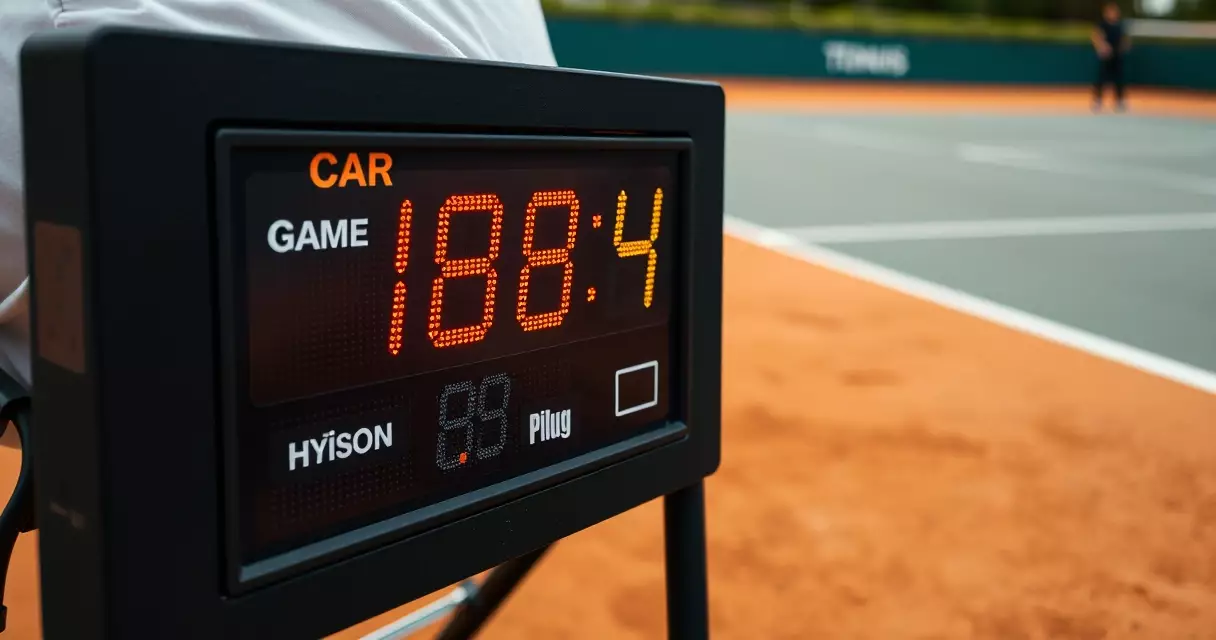
Reading a Single Game: Love, 15, 30, 40 and Deuce
A game is the smallest scoring unit you will track. One player serves for the entire game, and points are called server’s score first. So “30–15” means the server has won two points and the receiver one. To win the game outright, a player must reach four points with a margin of at least two, which is why the count runs love, 15, 30, 40, game.
The margin rule creates the most famous wrinkle in tennis: deuce. When both players reach 40, the score is not 40–40 but “deuce,” and a player must then win two points in a row to take the game. Win the first and you hold “advantage.” Win the next and the game is yours; lose it and the score returns to deuce. A single game can swing through deuce many times, which is how a routine hold can stretch past ten minutes.
The table below shows how raw points map to the calls you hear during play.
| Points won by a player | Spoken call |
|---|---|
| 0 | Love |
| 1 | 15 |
| 2 | 30 |
| 3 | 40 |
| 3 each (40–40) | Deuce |
| One ahead after deuce | Advantage |
| 4 (or 2 clear after deuce) | Game |
If you already read cricket, the logic of turning a raw tally into a coded display will feel familiar, and our guide on how to read cricket scorecards for beginners shows the same idea applied to a very different scoreboard. The skill transfers: learn the unit, then learn how units stack.
From Games to Sets to Matches
Games stack into sets. To win a set, a player must win six games with a margin of two, so 6–4 and 6–3 are standard set scores. At 6–5 the leader can serve out the set to make it 7–5. If the set reaches 6–6, almost every modern format switches to a tiebreak, which the next section covers in detail.
Sets then stack into a match. Here the format depends on the event and, historically, on the player’s gender. Men’s singles at the four Grand Slam tournaments is best of five sets, meaning the first to three sets wins, according to the ITF and Encyclopaedia Britannica. Women’s singles at the Slams, and almost all other professional singles for both tours, is best of three sets, so the first to two sets wins. A 6–4, 3–6, 7–5 result therefore describes a completed best-of-three match in which the winner took the first and third sets.
Written scorelines always list the winner’s games first within each set. Read “7–6, 6–7, 6–3” and you know the player named first took the opening set in a tiebreak, lost the second in a tiebreak, and closed out the third. Because the winner is listed first, a set the winner lost still shows their own game count first, which is why you see scores like 4–6 inside a winning line.
Understanding Tiebreaks
The tiebreak exists to stop sets from running on indefinitely. It was devised by James Van Alen in the 1960s, and the US Open became the first Grand Slam to adopt it in 1970, as documented by Encyclopaedia Britannica. In a standard tiebreak, the first player to seven points wins, again by a margin of two, so a tiebreak can end 7–3 or stretch to 11–9. Players switch ends every six points, and the serve rotates in a fixed pattern.
The parenthetical number you see in a result records the loser’s points in that tiebreak. In 7–6(5), the set went to a tiebreak and the player who lost it reached 5 points, so the tiebreak finished 7–5. When the digit is high, say (8) or (10), the tiebreak was a marathon and the set was extremely tight. That small number is the single most information-dense character on a tennis scoreboard.
Deciding sets used to be the messiest part of the rulebook. For decades the four Slams disagreed: the US Open played a normal tiebreak at 6–6 in the final set, the Australian Open used a 10-point tiebreak from 2019, Wimbledon introduced a tiebreak at 12–12 in 2019, and the French Open kept playing on until someone led by two games. That fragmentation ended when the Grand Slam Board announced on 16 March 2022 a single rule across all four majors: a 10-point tiebreak, won by two, played at 6–6 in the final set, as reported by Reuters. The change removed open-ended deciding sets from the Slams for good.
How Written Scorelines and Abbreviations Work
A results page uses a compact shorthand. Beyond the set scores and tiebreak digits already covered, a few abbreviations tell you how a match ended when it did not run its full course. The most common is “ret.,” meaning a player retired mid-match because of injury or illness; the opponent is credited with the win at the score reached. A “w/o” marks a walkover, where a player withdraws before play and the match is awarded without a ball struck.
| Symbol or abbreviation | Meaning |
|---|---|
| 6–4 | A completed set, winner’s games listed first |
| 7–6(5) | Set won in a tiebreak; loser reached 5 points |
| ret. | Opponent retired during the match |
| w/o | Walkover; opponent withdrew before play |
| def. | Defaulted, removed by the official for a rule breach |
Reading these codes is a learned habit, and it pays off across sports. Fans who track several games often build a mental dictionary of symbols, much like the one explained in our piece on cricket scorecard symbols and abbreviations. Once you know that “ret.” and “w/o” are not part of the score itself but a note about how it stopped, a results archive stops looking like code and starts telling stories.
One more habit helps: identify the winner first, then read across to see how the match tightened or eased. A line that reads 6–1, 4–6, 6–2 describes a player who dominated, dipped, then reasserted control. The shape of a match lives in its scoreline.
Match Formats Across Tours and Events
Not every match uses the same format, and the differences change how you read a result. Doubles, in particular, looks unusual to newcomers because the ATP and WTA tours use no-advantage scoring and replace the third set with a 10-point match tiebreak. Team competitions and exhibition events add further variations. The table below compares the most common formats you will meet in a results feed.
| Event or format | Match length | Deciding-set rule |
|---|---|---|
| Grand Slam, men’s singles | Best of 5 sets | 10-point tiebreak at 6–6 |
| Grand Slam, women’s singles | Best of 3 sets | 10-point tiebreak at 6–6 |
| ATP and WTA Tour singles | Best of 3 sets | 7-point tiebreak at 6–6 |
| ATP and WTA Tour doubles | Best of 3, no-ad games | 10-point match tiebreak instead of a 3rd set |
| Davis Cup ties | Best of 3 sets | 7-point tiebreak at 6–6 |
The “no-ad” rule shortens games by scrapping the advantage stage. At deuce, the next point simply wins the game, and the receiver chooses which side to return from. It speeds up doubles and is used in college tennis too. If you have followed how different cricket formats produce different scorecards, the parallel is direct, and our comparison of Test, ODI and T20 scorecard differences shows how format choices reshape what a result page displays.

Recent Changes That Affect How Results Are Recorded
Tennis scoring is not frozen. The 2022 unification of the final-set tiebreak, covered above, was the biggest recent rule change, and it means deciding sets at all four majors now end the same way. That consistency makes historical comparison easier and retires the old question of “which Slam are we at” before you could predict how a fifth set might finish.
A second shift is technological rather than mathematical. The ATP Tour moved to electronic line calling across all of its events from the 2025 season, retiring human line judges in favor of automated calls, and Wimbledon adopted the same technology for 2025, ending nearly 150 years of line judges at the All England Club, as reported by The Associated Press. This does not change the score itself, but it changes how a point is decided, and it has made challenge systems largely obsolete at the top level.
For the casual viewer, the practical upshot is reassuring. The core grammar of love, 15, 30, 40, games, sets, and tiebreaks has not changed in 2026. Recent reforms tidied the edges of the rulebook and modernized officiating, while the way you read a printed result stayed exactly the same.
Frequently Asked Questions
Why is zero called “love” in tennis?
The term has two leading explanations, and neither is fully proven. One traces “love” to the French word l’oeuf, meaning egg, because a written zero looks like an egg, a visual joke also found in the cricket term “duck.” The Oxford English Dictionary, as cited on Wikipedia, prefers a different origin: to do something “for love” historically meant to do it for nothing, so a player with no points had a score of nothing, or “love.” Whichever account you favor, the meaning on court is identical. Whenever an umpire calls “love,” read it as zero, whether it refers to points within a game or games within a set.
What does the small number in 7–6(5) mean?
That parenthetical figure is the losing player’s point total in the tiebreak that decided the set. A set listed as 7–6(5) reached six games each, triggered a tiebreak, and the player who lost the tiebreak finished with 5 points, so the breaker ended 7–5. Because a tiebreak must be won by two points, the bracketed number is at most five when the winner reaches seven, or it can be higher in a long breaker, such as (8) for a 10–8 finish. The smaller that number, the more one-sided the tiebreak was. It is one of the most informative single digits on a scoreboard.
Who is listed first in a written tennis score?
In published results, the winner of the match is named first, and within each set the winner’s game count is also written first. This convention holds even for sets the winner lost, which is why a champion’s line can include a score like 3–6. During live play, however, the calling rule is different: the umpire announces the server’s points first, so “30–15” means the server leads. Keeping these two conventions separate avoids confusion. When you scan a results archive, assume the first name won; when you listen to a live call, assume the first number belongs to whoever is serving that game.
What is the difference between deuce and advantage?
Deuce is the name for a 40–40 tie within a game, the point at which neither player can win on the next point because a two-point margin is required. From deuce, the player who wins the next point gains “advantage.” If that same player wins the following point, they take the game. If they lose it, the score returns to deuce and the cycle repeats. A game can pass through deuce many times before someone strings two points together. In no-advantage scoring, used widely in doubles, this back-and-forth is removed: the point played at deuce simply decides the game.
How many sets do you need to win a match?
It depends on the event. Men’s singles at the four Grand Slam tournaments is best of five sets, so a player must win three sets to take the match, according to the ITF and Encyclopaedia Britannica. Almost everywhere else, including all women’s professional singles and the regular ATP and WTA tour events for men, matches are best of three sets, meaning the first to two sets wins. Doubles follows the best-of-three pattern but often substitutes a 10-point match tiebreak for the deciding set. So the same player could need three sets to win at a major and only two sets at a regular tour stop the following week.
What changed about final-set tiebreaks in 2022?
Before 2022, the four Grand Slams handled a 6–6 score in the deciding set in four different ways, ranging from no tiebreak at all at the French Open to a tiebreak at 12–12 at Wimbledon. On 16 March 2022, the Grand Slam Board announced a single standard across all majors: a 10-point tiebreak, won by a margin of two, played once the final set reaches 6–6, as reported by Reuters. This ended the long, open-ended fifth sets that occasionally produced extreme scorelines. For viewers, it means every Slam now finishes a deciding set the same way, which makes results easier to compare across tournaments.
What does “ret.” mean in a result?
The abbreviation “ret.” stands for “retired” and signals that one player stopped during the match, usually because of injury, illness, or cramp. The opponent is awarded the win at the score that had been reached, which is why you might see a result like 6–3, 2–1 ret. Retirement is different from a walkover, marked “w/o,” where a player withdraws before the match begins and no points are played. It is also different from a default, marked “def.,” where an official removes a player for a code violation. All three notes describe how a match ended rather than forming part of the score.
Sources
- Wikipedia, Tennis scoring system – https://en.wikipedia.org/wiki/Tennis_scoring_system
- Encyclopaedia Britannica, Tennis – https://www.britannica.com/sports/tennis
- International Tennis Federation, Rules of Tennis – https://www.itftennis.com/en/about-us/governance/rules-and-regulations/
- Reuters, Grand Slams to use 10-point final-set tiebreak (16 March 2022) – https://www.reuters.com/lifestyle/sports/grand-slams-introduce-final-set-tiebreaks-2022-03-16/
- The Associated Press, tennis coverage of electronic line calling – https://apnews.com/hub/tennis
Further reading
Cricket Match Scorecards: Test, ODI & T20 Results Database