Summary
A regulation Major League Baseball game runs nine innings, yet the clock around it has changed dramatically. After the pitch timer arrived in 2023, the average nine-inning game fell to about 2 hours and 40 minutes, down roughly 24 minutes...
Table of contents
- 1 What an inning actually is
- 2 A short history of the nine-inning standard
- 3 The timeline of a single half-inning
- 4 Walking through all nine innings
- 5 How the pitch clock reshaped the timeline
- 6 Reading the line score across innings
- 7 Extra innings and called games
- 8 Why the timeline matters for summaries
- 9 Frequently asked questions
- 9.1 How many innings are in an MLB game?
- 9.2 How long does an average MLB game last now?
- 9.3 What happens in extra innings?
- 9.4 Why does the home team bat second?
- 9.5 What does the X mean in a line score?
- 9.6 When does a shortened game become official?
- 9.7 How many outs are in a full inning?
- 9.8 Does the pitch clock apply with runners on base?
- 10 Sources
A regulation Major League Baseball game runs nine innings, yet the clock around it has changed dramatically. After the pitch timer arrived in 2023, the average nine-inning game fell to about 2 hours and 40 minutes, down roughly 24 minutes from the 3:04 average MLB recorded in 2022. That single shift reshaped how a game unfolds minute by minute, but the underlying skeleton stayed the same: two teams, nine innings, three outs per half, and a rhythm that any fan can learn to read. This article walks through that timeline from the first pitch to the final out, so you can follow, reconstruct, or write about a game with confidence.
Understanding the inning-by-inning flow is the foundation beneath every recap, box score, and live tracker. Once the structure clicks, a line score stops looking like a grid of numbers and starts reading like a story with a beginning, a middle, and a finish. If you want the wider picture of how reports are built around this structure, the MLB game summaries hub ties these pieces together.
What an inning actually is
An inning is the basic unit of a baseball game, and each one splits into two halves. In the top half, the visiting team bats while the home team plays defense. In the bottom half, those roles flip. A half-inning ends when the batting team records three outs, so a full inning contains six outs total, three for each side. According to the overview of innings, this structure is what separates baseball from clock-bound sports: the game advances by outs, not by elapsed time.
The visiting team always bats first. This is not arbitrary. It gives the home team the advantage of batting last, meaning a home club trailing by a run in the ninth still gets a chance to respond, while a home club already ahead can skip its final at-bat entirely. That detail explains why some box scores show only 8.5 innings of offense for the winning side.
Three outs reset everything. Once the third out lands, the batting team’s runners are wiped off the bases, the fielders jog in, and the other side comes up. Runners stranded on base do not carry over to the next inning, which is why a team can leave the bases loaded and still score nothing. Learning to spot those stranded-runner moments is one of the first skills covered in reading an MLB box score.

A short history of the nine-inning standard
The nine-inning game was not always the rule. Early baseball, shaped by the Knickerbocker rules of 1845, often ended when one team reached 21 runs, sometimes called aces, rather than after a fixed number of innings. That meant games could be lopsided sprints or grinding marathons depending on how the runs fell. The Library of Congress documents how organized baseball formalized many of its conventions during the 1850s as the sport spread across the northeastern United States.
In 1857, a convention of clubs adopted the nine-inning, nine-player format that endures today, replacing the older first-to-21 finish. The change brought predictability and made games easier to schedule and compare. Encyclopaedia Britannica traces how these mid-19th-century decisions set the template that professional leagues, and eventually the American and National Leagues, would inherit.
Since then the nine-inning frame has held remarkably steady, even as nearly everything around it evolved. The National Baseball Hall of Fame chronicles the long arc of rule tweaks, from mound height adjustments to the designated hitter, none of which disturbed the core count of nine innings. That stability is precisely why the inning-by-inning timeline remains such a reliable way to read a game more than a century and a half later.
The timeline of a single half-inning
Zoom into one half-inning and a smaller rhythm appears. The pitcher and catcher set up, the leadoff batter steps in, and a sequence of pitches begins. Each plate appearance ends in one of a handful of ways: a hit, a walk, a strikeout, a ball put in play for an out, or a hit-by-pitch. The batting team keeps sending hitters until three outs accumulate.
Base runners advance through this sequence. A single typically moves a runner one base, a double moves the batter to second and often scores a runner from first, and so on. Stolen bases, sacrifice flies, wild pitches, and errors all shift runners outside the simple hit-by-hit progression. When a runner crosses home plate, a run scores, and the line score for that half-inning ticks up.
The order of events inside the half-inning matters enormously. Two singles followed by a double can plate two runs, while the same three hits in a different sequence might plate one or none. This is why play-by-play accounts read so differently from a static box score, a distinction explored in the comparison of summaries, box scores, and play-by-play.
Walking through all nine innings
Each inning tends to carry its own character, and broadcasters often narrate the game in three-inning chunks. The early innings, one through three, are about feeling out the starting pitchers and establishing whether a lineup can square up the day’s stuff. Leadoff hitters set a tone, and a quick scoreless top of the first can settle a nervous home crowd.
Middle innings, four through six, are where games frequently turn. Starting pitchers face the opposing lineup for the second and third time, and the data shows hitters perform better with each look. Managers begin warming relievers, and the first big strategic decisions about pitching changes arrive. A three-run rally in the fifth often defines the eventual recap.
Late innings, seven through nine, belong to the bullpen and to use. The seventh-inning stretch marks a customary pause, the eighth often brings a setup reliever, and the ninth, when a team leads, is the closer’s domain. A one-run lead in the ninth produces the tense, high-stakes moments that fans remember, and the metrics behind those swings are unpacked in our look at advanced stats such as win probability and use.
| Phase | Innings | Typical storyline | Who controls it |
|---|---|---|---|
| Early | 1–3 | Starters settle in, lineups take first looks | Starting pitchers |
| Middle | 4–6 | Rallies build, first pitching changes loom | Starters and pinch options |
| Late | 7–9 | Bullpen use, closer protects the lead | Relievers and closer |
| Extra | 10+ | Automatic runner raises scoring odds | Bench depth and bullpen |
How the pitch clock reshaped the timeline
The biggest change to game pacing in a generation arrived in 2023 with the pitch clock. Pitchers now work against a timer, and the effect on duration was immediate. As detailed in the record of the rule, the average nine-inning game dropped to roughly 2:40 in 2023 from about 3:04 the previous season, then edged down again toward 2:36 in 2024 after the timer with runners on base was trimmed.
The mechanics are specific. With the bases empty, a pitcher has 15 seconds to begin the delivery. With runners on, the allotment was 20 seconds in 2023 and was reduced to 18 seconds for 2024. The batter must be set in the box and looking at the pitcher with at least 8 seconds remaining, or risk an automatic strike. A pitcher who exceeds the clock is charged an automatic ball.
These rules also limit how often a pitcher can step off the rubber. A pitcher is allowed two disengagements, pickoff attempts or step-offs, per plate appearance; a third that fails to retire the runner results in a balk. The pace changes are part of a broader push toward accuracy and consistency that we discuss in best practices for trustworthy recaps.
| Rule element | 2023 | 2024 onward |
|---|---|---|
| Timer, bases empty | 15 seconds | 15 seconds |
| Timer, runners on base | 20 seconds | 18 seconds |
| Batter ready in box | 8 seconds left | 8 seconds left |
| Mound visits per game | 5 | 5 |
| Disengagements per plate appearance | 2 | 2 |
| Average nine-inning game | ~2:40 | ~2:36 |
Reading the line score across innings
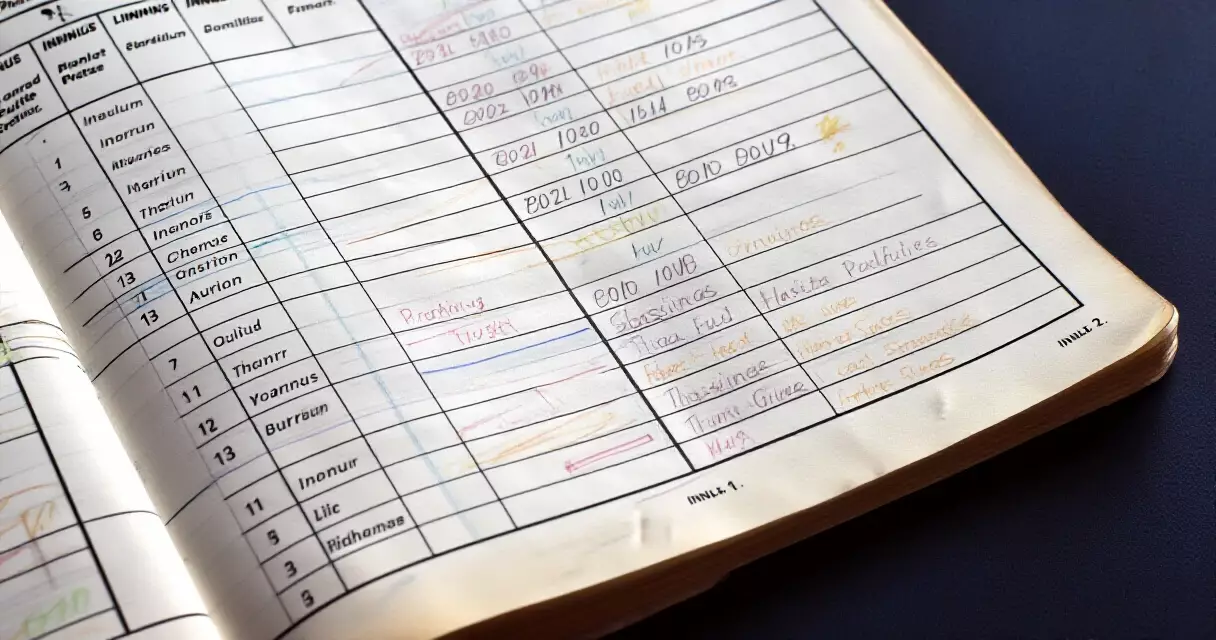
The line score is the compressed timeline of the game. It lists each team’s runs by inning across the top, followed by totals for runs, hits, and errors, the familiar R, H, and E columns. Reading left to right shows you exactly when the scoring happened, even if you never saw a single pitch.
Consider the sample below. The visiting team scored steadily, while the home team erupted for four runs in the sixth before falling short. A glance reveals the shape of the game: a back-and-forth contest decided in the middle innings, with the home side unable to add on late.
| Team | 1 | 2 | 3 | 4 | 5 | 6 | 7 | 8 | 9 | R | H | E |
|---|---|---|---|---|---|---|---|---|---|---|---|---|
| Visitors | 0 | 1 | 0 | 2 | 0 | 1 | 0 | 1 | 2 | 7 | 11 | 0 |
| Home | 1 | 0 | 0 | 0 | 0 | 4 | 0 | 0 | 0 | 5 | 9 | 1 |
One quirk worth knowing: when the home team leads after the visitors bat in the ninth, the home half is not played, and an X appears in that box instead of a number. A walk-off win, where the home team scores the deciding run in its final at-bat, also stops play instantly, so the inning may show fewer than three outs. Turning a line score like this into prose is the craft behind writing a recap readers finish.
Extra innings and called games
When the score is tied after nine innings, the game continues into extra innings, played one full inning at a time until one team leads after a complete inning. Since 2020, and made permanent for the regular season in 2023, each extra half-inning begins with an automatic runner placed on second base, sometimes called the ghost runner. As the summary of extra innings notes, the rule was introduced to shorten marathon games and reduce strain on pitching staffs.
The automatic runner sharply raises scoring odds, which is why extra-inning games now resolve faster than they once did. Postseason play is the exception: the automatic runner does not apply in the playoffs, so October games can still stretch deep into the night, a fact that occasionally produces the longest games of the year.
Weather adds another wrinkle. A game becomes official once the team that is behind has batted in five innings, or 4.5 innings if the home team leads. If rain or darkness stops play after that point, the game can be called and the result stands. Before that threshold, a halted game is typically suspended or replayed, which is why early-game rain delays carry higher stakes than late ones.
Why the timeline matters for summaries
Every well-built game summary leans on this inning-by-inning spine. A recap that simply lists final stats tells you who won; a recap organized around the timeline tells you how and when. Readers want the turning point, the inning where the game tilted, and that point only exists because the structure gives each run a place in time.
Knowing the structure also helps you catch errors. If a line score shows a team batting in the bottom of the ninth while already leading, something is off, because that half would not be played. Familiarity with what is supposed to happen each inning is the first defense against a mistaken report, a theme that runs through every article in the guide to what a game summary is.
For writers and data builders alike, the timeline is the organizing principle. Whether you produce a 200-word wire brief or a long feature, anchoring the narrative to specific innings keeps the account honest and easy to verify against the official record.
Frequently asked questions
How many innings are in an MLB game?
A standard Major League Baseball game is nine innings long. Each inning has two halves, with the visiting team batting in the top half and the home team batting in the bottom half. If the score is tied after nine innings, the game proceeds to extra innings and continues one inning at a time until one team is ahead at the end of a completed inning. The nine-inning format dates back to an 1857 convention of clubs, and despite countless rule changes since, the count of nine has remained the durable standard for the professional game.
How long does an average MLB game last now?
After the pitch clock was introduced in 2023, the average nine-inning game fell to roughly 2 hours and 40 minutes, down from about 3:04 in 2022. In 2024, after the timer with runners on base was reduced from 20 to 18 seconds, the average edged down further toward 2:36, as reported in league pace-of-play figures. Game length still varies with the number of pitching changes, baserunners, and total runs scored, so a high-scoring contest can run well past three hours even under the timer, while a brisk pitchers’ duel may finish in just over two.
What happens in extra innings?
If the game is tied after nine innings, teams play additional full innings until one leads after a complete inning. During the regular season, each extra half-inning starts with an automatic runner on second base, a rule introduced in 2020 and made permanent in 2023 to shorten long games. The automatic runner increases the chance of scoring, so extra-inning games tend to end sooner than they did historically. This rule does not apply in the postseason, which means playoff games can run many innings deep without the head start, occasionally producing the longest games of the entire season.
Why does the home team bat second?
The visiting team always bats first, in the top of each inning, and the home team bats in the bottom. Batting last is a built-in advantage: a home team trailing in its final at-bat still has a chance to tie or win, while a home team already leading after the visitors bat in the ninth does not need to bat at all. That is why a winning home team’s line score may show only eight and a half innings of offense, and why a walk-off hit can end the game the instant the deciding run scores, sometimes with fewer than three outs recorded in that half.
What does the X mean in a line score?
An X in the home team’s box for the ninth inning means that half-inning was not played because the home team already held the lead after the visitors finished batting. Since the game is decided, there is no reason for the home side to bat, so the box is marked with an X rather than a zero or a run total. Reading a line score from left to right shows when each team scored, and the R, H, and E columns at the end give the totals for runs, hits, and errors. Spotting an X is a quick way to confirm the home team won without needing the final line.
When does a shortened game become official?
A game becomes official once the losing team has batted in at least five innings, or after 4.5 innings if the home team is leading. If weather or darkness halts play after that threshold, the game can be called and the result stands. If play stops before that point, the game is usually suspended and resumed later or replayed entirely, depending on the situation and league policy. This rule is why early rain delays carry more uncertainty than late ones, since the game has not yet reached the point where the score in the books would count as a final result.
How many outs are in a full inning?
A full inning contains six outs, three recorded in each half. The batting team keeps sending hitters to the plate until it makes three outs, at which point the half-inning ends, any runners left on base are erased, and the teams switch between offense and defense. Outs come in many forms, including strikeouts, ground outs, fly outs, line outs, and force plays. Because runners stranded at the end of a half-inning do not carry over, a team can load the bases and still score nothing, which is one of the most common sources of frustration and drama in a tight game.
Does the pitch clock apply with runners on base?
Yes. With runners on base the pitcher has a longer allotment than with the bases empty, because pickoff considerations come into play. In 2023 the timer with runners on was 20 seconds, and it was reduced to 18 seconds beginning in 2024, while the bases-empty timer stayed at 15 seconds. A pitcher who exceeds the clock is charged an automatic ball, and a batter not set in the box with 8 seconds left is charged an automatic strike. Pitchers are also limited to two disengagements per plate appearance, such as step-offs or pickoff throws, with a failed third attempt ruled a balk.
Sources
- Inning, structure of half-innings and outs – https://en.wikipedia.org/wiki/Inning
- Pitch clock, timer rules and game-length effects – https://en.wikipedia.org/wiki/Pitch_clock
- Extra innings, automatic runner rule – https://en.wikipedia.org/wiki/Extra_innings
- Library of Congress, early baseball history – https://www.loc.gov/item/today-in-history/september-23/
- Encyclopaedia Britannica, baseball overview and rule history – https://www.britannica.com/sports/baseball
- National Baseball Hall of Fame, historical stories – https://baseballhall.org/discover-more/stories/short-stops
Cricket Match Scorecards: Test, ODI & T20 Results Database