
Summary
On 22 March 1992, the scoreboard at the Sydney Cricket Ground delivered one of the sport's most infamous numbers: South Africa, chasing a place in the World Cup final, suddenly needed 22 runs off a single ball. Moments earlier the...
Table of contents
- 1 Why an accurate scorecard is more than bookkeeping
- 2 A short history of keeping the score
- 3 The most common cricket scoring errors
- 4 Getting extras and the over count wrong
- 5 Misattributing wickets and bowling figures
- 6 When the maths goes wrong: rain rules and revised targets
- 7 Digital scorecards and the new generation of mistakes
- 8 A practical routine for error-free scoring
- 9 Frequently asked questions
- 9.1 What is the most common mistake cricket scorers make?
- 9.2 Why do two scorers keep separate records of the same match?
- 9.3 How do scorers avoid losing count of the balls in an over?
- 9.4 Are byes and leg byes charged to the bowler?
- 9.5 What happens when the scorers and the scoreboard disagree?
- 9.6 How are revised targets in rain-affected matches calculated?
- 9.7 Can a published scorecard be corrected after the match?
- 9.8 Do scoring apps eliminate human error?
- 10 Sources
On 22 March 1992, the scoreboard at the Sydney Cricket Ground delivered one of the sport’s most infamous numbers: South Africa, chasing a place in the World Cup final, suddenly needed 22 runs off a single ball. Moments earlier the equation had been 22 runs off 13 balls. A rain break and a flawed run-chase formula had turned a tense finish into a farce, and according to Wikipedia’s record of the 1992 Cricket World Cup, the outcry helped retire that scoring rule for good. The episode is an extreme example, yet it captures a truth every scorer learns quickly: a cricket scorecard is only as trustworthy as the person and the process behind it.
Most scoring mistakes are far quieter than a World Cup meltdown. A missed wide here, a run credited to the wrong batter there, an over counted as six legal balls when one was illegal. Small slips compound across an innings until the totals on the card no longer add up, and reconciling them after the fact can take longer than the match itself. This article walks through the errors that recur most often, why they happen, and the habits that keep a card clean from the first ball to the last.
Why an accurate scorecard is more than bookkeeping
A scorecard is the official memory of a cricket match. Selectors read it to judge form, statisticians fold it into career records, and broadcasters build graphics on top of it. When a figure is wrong, the error does not stay local. It travels into averages, into head-to-head databases, and into the historical archive where it can sit uncorrected for decades. That is why the people who govern the game treat scoring as a formal role rather than an afterthought.
The Laws of Cricket, maintained by Marylebone Cricket Club, devote an entire section to the task. The current 2017 Code, in its third edition of 2022, runs to 42 Laws, and Law 3, published by MCC, sets out exactly what scorers must do. Two scorers are appointed, they must record every run, wicket and over, and they are required to check their tallies against each other frequently throughout the innings. The redundancy is deliberate. Two independent records that agree are far more likely to be right than one record nobody cross-checks.
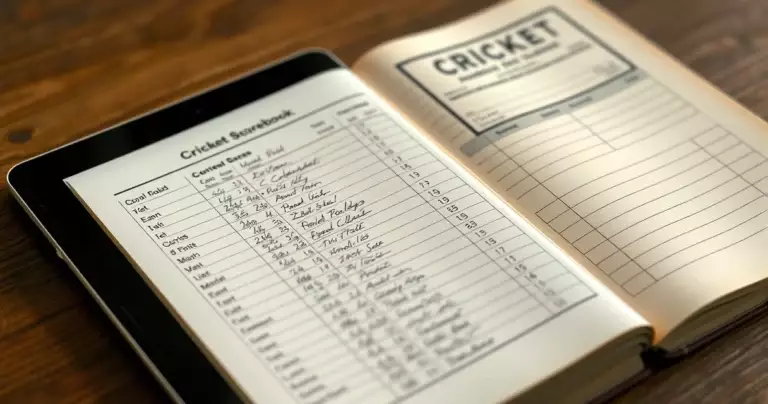
Understanding the anatomy of the card is the first defence against error. If you are still building that foundation, our beginner’s walkthrough of reading a scorecard explains how the batting block, bowling block and extras line fit together. Everything that follows here assumes you can already see where a stray number would land.
There is also a practical, real-time cost to mistakes. A miscount during a tight finish can send the wrong target to the players, exactly the failure that defines this whole subject. Getting it right under pressure is the skill; the routines below exist to make that skill repeatable.
A short history of keeping the score
Scoring began as little more than notches cut into a stick, which is where the cricketing term notch for a run comes from. As the game formalised through the eighteenth and nineteenth centuries, paper sheets replaced tally sticks, and a grid system emerged that recorded runs ball by ball alongside the bowler responsible. That basic layout, batters down one side and bowlers across the analysis, survives in essentially the same shape today.
The modern leap came with linear scoring, a method that lays the innings out as a continuous timeline so that the state of the game at any delivery can be reconstructed exactly. British scorer Bill Frindall popularised the linear system across decades of broadcasting, and his meticulous sheets became a benchmark for accuracy. The discipline behind that style, recording who was on strike, which end the bowler ran from, and what the umpire signalled, is precisely what stops the small errors this article is about.
Historical archives are not flawless, and that is instructive. The Association of Cricket Statisticians and Historians, founded in 1973 according to Wikipedia’s entry on the organisation, has spent years auditing old first-class scorecards and correcting totals that did not reconcile. Their work is a standing reminder that even printed, published cards can carry mistakes, and that careful reconstruction can still fix them long after the players have left the field.

The most common cricket scoring errors
Patterns repeat across club fixtures and international fixtures alike. The same handful of slips account for the large majority of cards that fail to balance at the close. Knowing the list in advance turns each one into something you actively watch for rather than discover after the damage is done.
The single most frequent root cause is a broken acknowledgment loop with the umpire. Law 3 expects the scorer to confirm receipt of every signal, and the umpire should wait for that confirmation before play continues. When a scorer is heads-down updating a previous ball and misses a raised arm, a wide or a leg bye can vanish from the record entirely. The total then drifts from reality by one or more runs, and the gap is rarely obvious until reconciliation.
| Error | Typical cause | Effect on the card | How to prevent it |
|---|---|---|---|
| Missed umpire signal | Scorer looking down, no acknowledgment given | Run or extra omitted; totals fail to reconcile | Acknowledge every signal before resuming, as Law 3 requires |
| Wrong batter on strike | Crossed runs or end changes after a wicket not tracked | Runs credited to the wrong player | Note striker and bowler’s end every ball in linear style |
| Over miscount | Wides and no-balls counted toward the six | Over closed early or late | Tick only legal deliveries toward the six |
| Extra misclassified | Bye logged as leg bye, or wide as no-ball | Bowler’s figures and extras line both wrong | Watch the umpire’s specific signal, not the outcome alone |
| Wicket misattributed | Run-out credited to the bowler | Bowling figures overstated | Apply the credit rules for each dismissal type |
| Running total slip | Arithmetic error in the cumulative tally | Whole card drifts from the true score | Reconcile the two scorers’ totals every few overs |
Notice how many of these failures share a remedy: record the same few details on every single delivery, and reconcile often. The shorthand that makes that possible is the set of symbols on the sheet itself. If a dot, a W or a circled number does not yet read instantly to you, the reference in our guide to scorecard symbols and abbreviations is worth keeping beside the book until the notation is second nature.
Getting extras and the over count wrong
Extras are where careful scorers earn their keep, because the category a run falls into changes how it is recorded in three places at once: the extras line, the team total, and the bowler’s analysis. Cricket recognises byes, leg byes, wides, no-balls and penalty runs, and each behaves differently. A wide and a no-ball are charged to the bowler and add to the team total, while byes and leg byes add to the team total but are not charged against the bowler. Mixing these up corrupts two columns from a single ball.
The over count is the other classic trap. An over is six legal deliveries, and the word legal is doing real work. A wide or a no-ball must be re-bowled and does not count toward the six, so an over containing two wides actually involves eight balls before it closes. Scorers who tick toward the six on every delivery, legal or not, will end the over early and quietly lose two balls of bowling from the record. Counting only legal balls toward the six is the fix, and it has to be automatic.
Penalty runs add a further wrinkle. Modern Laws allow five-run penalties for offences such as a fielding side damaging the pitch or the ball striking a fielder’s helmet on the ground, and these belong in the extras line without being attached to any individual bowler or batter. Because penalties are comparatively rare, they are easy to fumble; the safe habit is to pause, read the umpire’s full signal sequence, and write the penalty into the dedicated column rather than improvising a place for it.
| Extra | Added to team total? | Charged to the bowler? | Common mistake |
|---|---|---|---|
| Wide | Yes | Yes | Not re-counting the ball; closing the over a delivery early |
| No-ball | Yes | Yes | Forgetting any runs scored off it are recorded separately |
| Bye | Yes | No | Logged as a leg bye when the ball missed the bat and body |
| Leg bye | Yes | No | Credited as runs to the batter instead of to extras |
| Penalty runs | Yes | No | Attached to a player rather than the extras line |
One subtlety deserves emphasis. Runs scored off a no-ball, when the batter actually hits it and runs, are logged against the batter as runs from the bat, while the no-ball penalty itself sits in extras. Treating the whole event as a single lump of extras is a frequent slip that understates a batter’s score and overstates the extras column. Reading the ball as two layers, the penalty and then whatever the batters did, keeps both columns honest.
Misattributing wickets and bowling figures
A wicket is a headline moment, and in the rush to mark it scorers can credit it to the wrong column. Not every dismissal counts toward a bowler’s figures. Bowled, caught, leg before wicket, stumped and hit wicket are credited to the bowler. Run-out, obstructing the field, timed out and retired out are not, because the bowler did not cause them. Hand a run-out to the bowler and the analysis inflates; the player’s career average then carries an error that future scorecards will faithfully repeat.
The fall-of-wickets line is its own hazard. It records the team score at the moment each wicket fell and which batter departed, and it must agree with both the batting block and the running total. A transposed digit here, 87 written as 78, can pass unnoticed during play and only surface when someone tries to reconcile the innings. Reading the team total aloud as each wicket falls, and writing it immediately, keeps the sequence anchored to reality.
| Dismissal | Credited to the bowler? | Recorded against |
|---|---|---|
| Bowled | Yes | Bowler and batter |
| Caught | Yes | Bowler, catcher noted |
| Leg before wicket (lbw) | Yes | Bowler and batter |
| Stumped | Yes | Bowler, wicket-keeper noted |
| Hit wicket | Yes | Bowler and batter |
| Run out | No | Batter only, fielder noted |
| Obstructing the field | No | Batter only |
| Retired out / timed out | No | Batter only |
These attribution rules are also where scorecards turn into statistics, so an error here ripples furthest. A bowling average, a strike rate and an economy figure all depend on wickets and runs being assigned to the right player. Readers who want to see how those numbers are derived can follow our piece on analysing cricket statistics from scorecards, which makes plain why a single misattributed wicket can distort a season’s worth of data.
When the maths goes wrong: rain rules and revised targets
Some of the most consequential scoring errors are not transcription slips at all, but failures of calculation when weather shortens a limited-overs match. The 1992 World Cup semi-final remains the cautionary tale. Under the Most Productive Overs rule then in force, a brief rain stoppage stripped South Africa’s chase of overs while barely reducing the runs required, producing the absurd 22-off-one-ball finish recorded in Wikipedia’s account of the tournament. The rule did not lie about the score; it simply produced an unfair revised target, which is its own species of error.
The replacement was the Duckworth-Lewis method, devised by statisticians Frank Duckworth and Tony Lewis. According to Wikipedia’s entry on the method, it was first used in an international fixture on 1 January 1997 and was formally adopted by the International Cricket Council in 1999, becoming the standard tool for rain-affected one-day matches. The pair set out the statistical reasoning in a peer-reviewed paper, A fair method for resetting the target in interrupted one-day cricket matches, published in the Journal of the Operational Research Society in 1998 and indexed by Taylor & Francis. The method was later refined and renamed Duckworth-Lewis-Stern in 2014 when Australian academic Steven Stern took over its custodianship.
For a scorer, the lesson is not to memorise the DLS formula, which is now embedded in official software, but to feed it correct inputs. The revised target depends on overs remaining and wickets lost at the moment of interruption, so a scorecard that already carries a wicket or over error will hand the calculator bad data and produce a bad target. Accurate ball-by-ball scoring is therefore the foundation on which every rain calculation rests; the maths can only be as fair as the numbers underneath it.
It also matters that the format dictates the rules. A revised target makes sense in an ODI or T20 but has no place in a timeless Test, where the structure of innings and follow-ons works differently. Scorers moving between formats have to switch mental models, and our comparison of Test, ODI and T20 scorecard differences lays out exactly which conventions change so that a habit from one format does not become a mistake in another.
Digital scorecards and the new generation of mistakes
Scoring apps and tablet-based systems have transformed the job since the mid-2010s, and by 2026 ball-by-ball digital scoring is the norm from international fixtures down to club leagues. Software automates the arithmetic, validates that an over has six legal balls, and pushes live data to spectators within seconds. Much of the old drudgery, and many of the old slips, have simply been engineered away. The trade is that digital scoring introduces failure modes that paper never had.
Connectivity is the obvious one. A dropped network link can desynchronise the on-ground record from the published feed, so spectators see a frozen or wrong score even when the local entry is correct. Battery failure mid-session, an accidental undo, or tapping the wrong batter on a crowded touchscreen are the modern equivalents of a smudged pencil line. The mechanics of these live pipelines, and where they break, are covered in our explainer on how live cricket scorecard updates work.
Automation can also breed complacency, which is its quietest danger. When the app refuses to close an over until six legal balls are logged, a scorer may stop counting independently and trust the prompt completely. That works until a delivery is entered under the wrong category, at which point the software validates a wrong number perfectly happily. The defence has not changed since the days of tally sticks: watch the umpire, acknowledge every signal, and keep a parallel record so that two independent versions can be compared.
Choosing the right tool matters too, since features for validation, undo history and reconciliation vary widely between platforms. Anyone weighing options will find a structured rundown in our review of the best cricket scorecard apps and websites, which compares how the leading systems guard against exactly the errors described here.

A practical routine for error-free scoring
Reliable scoring is less about talent than about a routine repeated identically on every ball. The strongest scorers build a small loop they never break: read the umpire, acknowledge the signal, record the delivery in full, then update the running total. Done the same way each time, the loop leaves no room for the gaps where errors hide.
- Before play, agree with the umpires on signalling and confirm both scorers are using the same conventions.
- On every delivery, note the striker, the bowler’s end, and exactly what the umpire signalled.
- Acknowledge each signal so the umpire knows it was received, as Law 3 requires.
- Count only legal balls toward the six in an over, and re-bowl wides and no-balls in your head before closing it.
- Classify each extra deliberately: bye, leg bye, wide, no-ball or penalty, never by guesswork.
- Reconcile the two scorers’ totals every few overs rather than waiting for the interval.
- At the fall of each wicket, write the team total and the departing batter immediately.
- Keep the linear sheet or app history intact so any disputed ball can be reconstructed.
Reconciliation deserves the most emphasis because it catches what individual discipline misses. When two independently kept records agree on the total, the wickets and the over count, the probability that both contain the same hidden error is low. When they disagree, the disagreement itself flags the exact area to investigate before the trail goes cold. This is the practical genius behind the two-scorer requirement, and it is the habit most often skipped in casual fixtures, which is precisely why casual fixtures produce the most unbalanced cards.
For the bigger picture of how these clean records feed an entire results archive, the cricket match scorecards database shows what well-kept cards look like once they are published and indexed. Every reliable entry in a database like that began with a scorer who refused to break the loop.
Frequently asked questions
What is the most common mistake cricket scorers make?
The error that recurs most often is missing an umpire’s signal because the scorer is still writing up the previous ball. Under Law 3 of the MCC Laws of Cricket, the scorer is supposed to acknowledge every signal, and the umpire should wait for that acknowledgment before play resumes. When the loop breaks, a wide, a leg bye or a penalty can drop out of the record entirely. The total then drifts from the true score by one or more runs, and because nothing on the card looks obviously wrong, the gap usually surfaces only during reconciliation. Building an unbroken read-acknowledge-record routine on every delivery is the single most effective prevention.
Why do two scorers keep separate records of the same match?
The Laws of Cricket appoint two scorers precisely so their records can be cross-checked. The principle is redundancy: two independent accounts that agree on the total, the wickets and the over count are far more trustworthy than a single record nobody verifies. When the two disagree, the disagreement pinpoints the area that needs investigation while the match is still fresh, rather than weeks later when memories have faded. Traditionally each side supplied a scorer, which added a layer of mutual accountability. Even in the digital era, where one app can run the whole match, serious competitions retain the two-scorer model because reconciliation catches errors that no individual, however careful, reliably catches alone.
How do scorers avoid losing count of the balls in an over?
An over consists of six legal deliveries, and the word legal is the key. Wides and no-balls must be re-bowled and do not count toward the six, so an over with two wides actually involves eight deliveries before it ends. The reliable method is to tick toward the six only when a delivery is legal, and to treat every wide or no-ball as a separate event that does not advance the count. Modern scoring software enforces this automatically by refusing to close an over until six legal balls are logged, but scorers should still count independently, because the app will happily validate the wrong total if a delivery is entered under the wrong category.
Are byes and leg byes charged to the bowler?
No. Byes and leg byes are added to the team total and recorded in the extras line, but they are not charged against the bowler’s analysis, because the bowler did not concede them off the bat. Wides and no-balls behave differently: they are charged to the bowler as well as added to the team total. Misclassifying any of these corrupts two columns from a single ball, since the extras line and the bowling figures both depend on the category being right. The safe habit is to watch the umpire’s specific signal rather than infer the category from the outcome, because the way the ball reached the boundary does not by itself tell you whether it was a bye, a leg bye or a delivery off the bat.
What happens when the scorers and the scoreboard disagree?
The scorers’ official record is the authority, not the public scoreboard or the live feed. A scoreboard is a display driven from the scorers’ data, and it can lag, freeze or desynchronise, especially when a network connection drops on a digital system. When a discrepancy appears, the umpires and scorers reconcile the two written records against each other to establish the correct figure, then update the display. This is one more reason the two-scorer method matters: if both independent books agree, the board is simply wrong and can be corrected with confidence. If the books disagree, the linear sheet or the app’s ball-by-ball history lets officials reconstruct the disputed passage delivery by delivery until the true score is settled.
How are revised targets in rain-affected matches calculated?
Limited-overs matches shortened by weather use the Duckworth-Lewis-Stern method, which the International Cricket Council adopted after the original Duckworth-Lewis system was first used internationally on 1 January 1997. The method resets the chasing side’s target based on the overs remaining and the wickets already lost at the moment of interruption, replacing cruder earlier rules such as the Most Productive Overs formula that produced the notorious 1992 World Cup semi-final result. Scorers do not compute the formula by hand today; it is built into official software. Their job is to supply correct inputs, because a target is only as fair as the over count and wicket tally feeding it. An earlier scoring error will quietly produce a wrong revised target.
Can a published scorecard be corrected after the match?
Yes, and it happens more often than casual followers expect. Errors discovered after publication can be amended once the correct figures are established, usually by reconciling the two scorers’ records or, for older matches, by reconstructing the innings from surviving sheets. The Association of Cricket Statisticians and Historians, founded in 1973, has corrected numerous historical first-class scorecards whose totals did not balance, sometimes decades after the matches were played. Corrections do carry weight, because statistics ripple outward into averages and records, so changing a figure can alter a player’s career data. That is exactly why getting the card right in the first place, through disciplined recording and frequent reconciliation, saves far more effort than fixing it later.
Do scoring apps eliminate human error?
They reduce certain errors but introduce others. Apps automate arithmetic, validate that an over contains six legal balls, and push live data to spectators within seconds, which removes much of the slip-prone manual maths that paper scoring involved. What they cannot do is judge what the umpire signalled or whether the right batter is on strike; those are still human inputs. A wide entered as a leg bye, or runs tapped against the wrong player, will be validated by the software just as confidently as a correct entry. Connectivity drops, accidental undos and battery failure are additional digital-only failure modes. The enduring defences, watching the umpire and keeping a second independent record, still apply.
Sources
- MCC, Laws of Cricket, Law 3 The Scorers – https://www.lords.org/mcc/the-laws-of-cricket/the-scorers
- Wikipedia, Scoring (cricket) – https://en.wikipedia.org/wiki/Scoring_(cricket)
- Wikipedia, Duckworth–Lewis–Stern method – https://en.wikipedia.org/wiki/Duckworth%E2%80%93Lewis%E2%80%93Stern_method
- Wikipedia, 1992 Cricket World Cup – https://en.wikipedia.org/wiki/1992_Cricket_World_Cup
- Wikipedia, Association of Cricket Statisticians and Historians – https://en.wikipedia.org/wiki/Association_of_Cricket_Statisticians_and_Historians
- Duckworth, F. C. and Lewis, A. J., A fair method for resetting the target in interrupted one-day cricket matches, Journal of the Operational Research Society (1998), via Taylor & Francis – https://www.tandfonline.com/doi/abs/10.1057/palgrave.jors.2600524